Showing posts with label Word Types. Show all posts
Showing posts with label Word Types. Show all posts
Saturday, June 29, 2013
June 29: Blended Words Day
On this date in 1995, Diane White, writing in The Boston Globe, coined the blended word bridezilla (bride + Godzilla) to describe "brides who are particularly difficult and obnoxious." White's neologism follows a trend that began in the 20th century of combining two words to form a single new word. Blends are also called portmanteau words, portmanteau being the French term for a suitcase with two compartments.


Tuesday, July 27, 2010
July 27: SMOG Day
Today is the anniversary of the coinage of the word smog. On July 27, 1905 the London Globe reported: "At a meeting of the Public Health Congress Dr. Des Voeux did a public service in coining a new word for the London fog, which was referred to as smog, a compound of smoke and fog" (1). Smog is just one example of a class of English words know as blends (a.k.a. portmanteau words).
The London fog of Dickens and Hollywood was certainly less romantic than it appeared. The major culprit of the city's dark fog was coal burning; it seems appropriate that a physician would be the one to appear on the scene to name the culprit and to try to clear it up.
When it comes to writing, there is another kind of SMOG know as the Simple Measure Of Gobbledygook. This type of SMOG is a test of a text's readability, based on a formula devised by reading researcher G. Harry McLaughlin. McLaughlin says he designed his formula in 1969 BC [Before Computers], to give educators an easy method of calculating the grade level of a given text.
The readability formula works like this: First, select three, 10-sentence samples from the text. Second, count the words in the text that are 3 or more syllables. Third, estimate the count's square root, and add 3. The resulting number will correspond to the estimated grade-level of the text.
The list below shows the SMOG levels followed by examples of periodicals that have text at the different grade levels:
-0 - 6 low-literate: Soap Opera Weekly
-7 junior high school: True Confessions
-8 junior high school: Ladies Home Journal
-9 some high school: Reader's Digest
-10 some high school: Newsweek
-11 some high school: Sports Illustrated
-12 high school graduate: Time Magazine
-13 - 15 some college: New York Times
-16 university degree: Atlantic Monthly
-17 - 18 post-graduate studies: Harvard Business Review
-19+ post-graduate degree: IRS Code (2).
Today, in the age of computers, you can use the SMOG Formula online by simply cutting and pasting your text. This post, for example, comes in at 11.02 on the SMOG Index.
The word gobbledygook, however, refers to more than just multisyllabic words. It means unintelligible language, especially jargon or bureaucratese.
The word was coined by Texas lawyer and Democratic Congressman Maury Maverick. He created the word in 1944 when referring to the obscure, smoggy language used by his colleagues. The used the turkey as a metaphor, since the bird is “always gobbledy gobbling and strutting with ludicrous pomposity.”
It should be noted that word origins ran in the Maverick family. Maury's grandfather was Samuel Maverick, the Texas rancher who became famous and eponymous for his unconventional practice of not branding his cattle. Of course today a maverick is anyone who stands outside the crowd, or herd, defying the status quo (3).
One organization defying SMOG is the Plain English Campaign based in New Mills, Derbyshire, England. Their stated mission is to fight "for crystal-clear language and against jargon, gobbledygook and other confusing language."
Each year the Plain English Campaign presents The Golden Bull Awards for the year's worst examples of gobbledygook. Here is one example of a 2004 winner:
British Airways for terms and conditions
CHARGES FOR CHANGES AND CANCELLATIONS NOTE – CANCELLATIONS – BEFORE DEPARTURE FARE IS REFUNDABLE. IF COMBINING A NON-REFUNDABLE FARE WITH A REFUNDABLE FARE ONLY THE Y/C/J-CLASS HALF RETURN AMOUNT CAN BE REFUNDED. AFTER DEPARTURE FARE IS REFUNDABLE. IF COMBINING A NON-REFUNDABLE FARE WITH A REFUNDABLE FARE REFUND THE DIFFERENCE /IF ANY/BETWEEN THE FARE PAID AND THE APPLICABLE NORMAL BA ONEWAY FARE. CHANGES/UPGRADES- PERMITTED ANYTIME (4).
Today's Challenge: Clear the SMOG
Below are examples given by the Plain English Campaign of sentences containing gobbledygook. Rewrite each sentence, eliminating the gobbledygook and replacing it with clear English.
1. High-quality learning environments are a necessary precondition for facilitation and enhancement of the ongoing learning process.
2. If there are any points on which you require explanation or further particulars we shall be glad to furnish such additional details as may be required by telephone.
3. It is important that you shall read the notes, advice and information detailed opposite then complete the form overleaf (all sections) prior to its immediate return to the Council by way of the envelope provided.
Quote of the Day: The great enemy of clear language is insincerity. When there is a gap between one's real and one's declared aims, one turns, as it were, instinctively to long words and exhausted idioms, like a cuttlefish squirting out ink. --George Orwell Suggested
Answers: 1. Children need good schools if they are to learn properly. 2. If you have any questions, please ring. 3. Please read the notes opposite before you fill in the form. Then send it back to us as soon as possible in the envelope provided.
1 - Funk, Charles Earle. Thereby Hangs a Tale: Stories of Curious Word Origins. New York: HarperPerennial, 1950.
2 - McLaughlin, G. Harry. SMOG: SImple Measure of Gobbledygook. http://www.harrymclaughlin.com/SMOG.htm
3 - Quinion, Michael. "GOBBLEDYGOOK OR GOBBLEDEGOOK." World Wide Words. http://www.worldwidewords.org/weirdwords/ww-gob1.htm 4 - http://www.plainenglish.co.uk/index.html
Monday, August 13, 2007
August 13: Americanisms from the 1950s Day
Today is the anniversary of an article published in the show-business magazine Variety that featured a new word. The article published on August 13, 1950 used the term disc jockey for the first time in its reporting the phenomenon of New York radio hosts selecting and playing phonograph records for an eager audience of young fans of popular music. The term stuck, sometimes abbreviated as DJ or deejay. DJ is an example of an Americanism, an English word or expression that is born in the U.S.A. and that is used in the writing and speech of Americans.
The book America in So Many Words by David K. Barnhart and Allan A. Metcalf documents Americanisms from the 1600s to the end of the 20th century. For each year, the authors select a single representative Americanism that was "newly coined or newly prominent." Looking at the words and the background of each is a reminder that every English word is like a fossil or an archaeological artifact that reveals the attitudes and trends of the age in which it was coined.
The below list of Americanisms from 1949 to 1960, for example, gives interesting insights into the characteristics of post-war America; the list also foreshadows several political, cultural, social, and economic trends that would emerge in the second half of the 20th century.
1949 cool
1950 DJ
1951 rock and roll
1952 Ms.
1953 UFO
1954 Fast Food
1955 hotline
1956 brinkmanship
1957 role model
1958 Murphy's Law
1959 software
1960 sit-in (1)
If English is the global language of the 21st century, then it is certainly American English which is the most influential variety of English. Whereas the English language of the British Empire dominated and propagated English around the world in the first half of the 20th century, American English, since the end of World War II, has exported English even farther than the Brits, via satellite and computer technology.
Even as early as 1780, John Adams envisioned this linguistic American Revolution:
English is destined to be in the next and succeeding centuries more generally the language of the world than Latin was in the last or French is in the present age. The reason of this is obvious, because the increasing population in America, and their universal connection and correspondence with all nations will, aided by the influence of England in the world, whether great or small, force their language into general use.
One aspect that characterizes the American variety of English is its brevity. Americanisms are typically single syllable words or at least single syllable compounds. Americanisms include a variety of classifications that produce words that are short and sweet:
Americanisms are clipped words (such as fan from fanatic), blends (such as motel from motor + hotel), abbreviations (such as Ms. from mistress), initialisms (such as UFO from Unidentified Flying Object), and acronyms (such as AWOL from absent without leave).
In fact, even the word acronym is an Americanism that emerged from the government and military build-up of World War II to give Americans a way to compress multiple-word expressions into easy-to-communicate small packages. This Americanism uses Greek roots: acro- meaning top, peak, or initial and -nym meaning name. Using the initial letters of words, acronyms condense names, titles, or phrases into single words, such as radar for radio detection and ranging.
Today's Challenge: Born in the U.S.A.
Given the number of letters and a brief definition, see if you can identify the Americanisms below. None are more than four letters long
1. Three-letter word in response to someone stating to obvious.
2. A three-letter clipped word that emerged from rap music and its performers' desire for respect.
3. Two-letter initialism that reflects the American faith in the ability to measure anything, including the quality of a person's gray matter.
4. A three-letter clipped word that refers to any liquid, especially a sticky one.
5. A frequently used two-letter initialism with two different meanings. The first came out of the world of technology; the second meaning came out of the multicultural movement.
6. A two-letter initialism that refers to American soldiers.
7. A four-letter acronym that evolved from the Civil War to refer to soldiers who fled the battlefield or their assigned posts.
8. A three-letter initialism that reflects the American tendency to live life at a fast pace and to get things done in a hurry.
Quote of the Day: Thus the American, on his linguistic side, likes to make his language as he goes along, and not all the hard work of his grammar teachers can hold the business back. A novelty loses nothing by the fact that it is a novelty; it rather gains something, and particularly if it meets the national fancy for the terse, the vivid, and, above all, the bold and imaginative. —H. L. Mencken
Answers:1. duh (1963) 2. dis (1986) 3. IQ (1916) [intelligence quotient] 4. goo (1902) 5. PC (1990) [personal computer; politically correct] 6. GI (1917) [See Word Daze June 22 GI Day 7. AWOL [absent without leave] (1863) 8. P.D.Q [Pretty Darn Quick] (1875)
1- Barnhart, David K. and Alla A. Metcalf. America in So Many Words: Words That Have Shaped America. Boston: Houghton Mifflin Company, 1997.
2 - Algeo, John. "Americans are Ruining English." Language Myth #21. Do You Speak American? PBS.http://www.pbs.org/speak/words/sezwho/ruining/
The book America in So Many Words by David K. Barnhart and Allan A. Metcalf documents Americanisms from the 1600s to the end of the 20th century. For each year, the authors select a single representative Americanism that was "newly coined or newly prominent." Looking at the words and the background of each is a reminder that every English word is like a fossil or an archaeological artifact that reveals the attitudes and trends of the age in which it was coined.
The below list of Americanisms from 1949 to 1960, for example, gives interesting insights into the characteristics of post-war America; the list also foreshadows several political, cultural, social, and economic trends that would emerge in the second half of the 20th century.
1949 cool
1950 DJ
1951 rock and roll
1952 Ms.
1953 UFO
1954 Fast Food
1955 hotline
1956 brinkmanship
1957 role model
1958 Murphy's Law
1959 software
1960 sit-in (1)
If English is the global language of the 21st century, then it is certainly American English which is the most influential variety of English. Whereas the English language of the British Empire dominated and propagated English around the world in the first half of the 20th century, American English, since the end of World War II, has exported English even farther than the Brits, via satellite and computer technology.
Even as early as 1780, John Adams envisioned this linguistic American Revolution:
English is destined to be in the next and succeeding centuries more generally the language of the world than Latin was in the last or French is in the present age. The reason of this is obvious, because the increasing population in America, and their universal connection and correspondence with all nations will, aided by the influence of England in the world, whether great or small, force their language into general use.
One aspect that characterizes the American variety of English is its brevity. Americanisms are typically single syllable words or at least single syllable compounds. Americanisms include a variety of classifications that produce words that are short and sweet:
Americanisms are clipped words (such as fan from fanatic), blends (such as motel from motor + hotel), abbreviations (such as Ms. from mistress), initialisms (such as UFO from Unidentified Flying Object), and acronyms (such as AWOL from absent without leave).
In fact, even the word acronym is an Americanism that emerged from the government and military build-up of World War II to give Americans a way to compress multiple-word expressions into easy-to-communicate small packages. This Americanism uses Greek roots: acro- meaning top, peak, or initial and -nym meaning name. Using the initial letters of words, acronyms condense names, titles, or phrases into single words, such as radar for radio detection and ranging.
Today's Challenge: Born in the U.S.A.
Given the number of letters and a brief definition, see if you can identify the Americanisms below. None are more than four letters long
1. Three-letter word in response to someone stating to obvious.
2. A three-letter clipped word that emerged from rap music and its performers' desire for respect.
3. Two-letter initialism that reflects the American faith in the ability to measure anything, including the quality of a person's gray matter.
4. A three-letter clipped word that refers to any liquid, especially a sticky one.
5. A frequently used two-letter initialism with two different meanings. The first came out of the world of technology; the second meaning came out of the multicultural movement.
6. A two-letter initialism that refers to American soldiers.
7. A four-letter acronym that evolved from the Civil War to refer to soldiers who fled the battlefield or their assigned posts.
8. A three-letter initialism that reflects the American tendency to live life at a fast pace and to get things done in a hurry.
Quote of the Day: Thus the American, on his linguistic side, likes to make his language as he goes along, and not all the hard work of his grammar teachers can hold the business back. A novelty loses nothing by the fact that it is a novelty; it rather gains something, and particularly if it meets the national fancy for the terse, the vivid, and, above all, the bold and imaginative. —H. L. Mencken
Answers:1. duh (1963) 2. dis (1986) 3. IQ (1916) [intelligence quotient] 4. goo (1902) 5. PC (1990) [personal computer; politically correct] 6. GI (1917) [See Word Daze June 22 GI Day 7. AWOL [absent without leave] (1863) 8. P.D.Q [Pretty Darn Quick] (1875)
1- Barnhart, David K. and Alla A. Metcalf. America in So Many Words: Words That Have Shaped America. Boston: Houghton Mifflin Company, 1997.
2 - Algeo, John. "Americans are Ruining English." Language Myth #21. Do You Speak American? PBS.http://www.pbs.org/speak/words/sezwho/ruining/
Wednesday, August 01, 2007
August 1: Capitonym Day
August First is one of the most august days on the calendar.
August is the month named for the first Roman emperor Octavian Augustus Caesar, whose uncle was Julius Caesar. Emulating his Uncle Julius, for whom July is name, Augustus wanted his own month. August was created in his honor, based on the official title Augustus that the Roman Senate gave Octavian (1).
The opening sentence of this post demonstrates that August/august is a capitonym.
A capitonym is a word that changes pronunciation and meaning depending on whether or not it is capitalized; therefore, an August dinner party is quite different from an august dinner party.
Here's a short poem from Richard Lederer's Word Circus containing four examples of capitonyms:
Job's Job
In August, an august patriarch
Was reading an ad in Reading, Mass.
Long-suffering Job secured a job
To polish piles of Polish brass (2)
Today's Challenge: Begin August with an August Word Challenge
Fill in the blanks below with the appropriate capitonyms.
1. We had a ______ two-week vacation in _____, France.
2. Yesterday was a ________ day than today on Mount __________.
3. We walked all over _____, Peru looking for a place to buy some ______ beans.
4. Don't ________ Ron by asking him to correctly pronounce the name of the _______ River.
5. As a child Mark _________'s hockey gear always made his room much _________ than his sister's room.
Quote of the Day: Smell brings to mind... a family dinner of pot roast and sweet potatoes during a myrtle-mad August in a Midwestern town. Smells detonate softly in our memory like poignant land mines hidden under the weedy mass of years. --Diane Ackerman
Answers: 1. nice (NICE - NEECE) 2. rainier - (RANE-ee-er, ray-NEER)3. lima (LEE-ma, LIE-ma) embarras (em-BAR-rass, AUM-bro) 5. messier (mess-ee-AYE, mess-ee-ER)
1- Funk, Wilfred. Word Origins and Their Romantic Stories. New York: Grosset & Dunlap, 1950.
2 - Lederer, Richard. The Word Circus. Springfield, Mass.: Merriam-Webster, Incorporated, 1998.
Friday, July 27, 2007
July 27: SMOG Day

Today is the anniversary of the coinage of the word smog. On July 27, 1905 the London Globe reported: "At a meeting of the Public Health Congress Dr. Des Voeux did a public service in coining a new word for the London fog, which was referred to as smog, a compound of smoke and fog" (1). Smog is just one example of a class of English words know as blends (a.k.a. portmanteau words).
The London fog of Dickens and Hollywood was certainly less romantic than it appeared. The major culprit of the city's dark fog was coal burning; it seems appropriate that a physician would be the one to appear on the scene to name the culprit and to try to clear it up.
When it comes to writing, there is another kind of SMOG know as the Simple Measure Of Gobbledygook. This type of SMOG is a test of a text's readability, based on a formula devised by reading researcher G. Harry McLaughlin. McLaughlin says he designed his formula in 1969 BC [Before Computers], to give educators an easy method of calculating the grade level of a given text.
The readability formula works like this: First, select three, 10-sentence samples from the text. Second, count the words in the text that are 3 or more syllables. Third, estimate the count's square root, and add 3. The resulting number will correspond to the estimated grade-level of the text.
The list below shows the SMOG levels followed by examples of periodicals that have text at the different grade levels:
-0 - 6 low-literate: Soap Opera Weekly
-7 junior high school: True Confessions
-8 junior high school: Ladies Home Journal
-9 some high school: Reader's Digest
-10 some high school: Newsweek
-11 some high school: Sports Illustrated
-12 high school graduate: Time Magazine
-13 - 15 some college: New York Times
-16 university degree: Atlantic Monthly
-17 - 18 post-graduate studies: Harvard Business Review
-19+ post-graduate degree: IRS Code (2).
Today, in the age of computers, you can use the SMOG Formula online by simply cutting and pasting your text. This post, for example, comes in at 11.02 on the SMOG Index.
The word gobbledygook, however, refers to more than just multisyllabic words. It means unintelligible language, especially jargon or bureaucratese.
The word was coined by Texas lawyer and Democratic Congressman Maury Maverick. He created the word in 1944 when referring to the obscure, smoggy language used by his colleagues. The used the turkey as a metaphor, since the bird is “always gobbledy gobbling and strutting with ludicrous pomposity.”
It should be noted that word origins ran in the Maverick family. Maury's grandfather was Samuel Maverick, the Texas rancher who became famous and eponymous for his unconventional practice of not branding his cattle. Of course today a maverick is anyone who stands outside the crowd, or herd, defying the status quo (3).
One organization defying SMOG is the Plain English Campaign based in New Mills, Derbyshire, England. Their stated mission is to fight "for crystal-clear language and against jargon, gobbledygook and other confusing language."
Each year the Plain English Campaign presents The Golden Bull Awards for the year's worst examples of gobbledygook. Here is one example of a 2004 winner:
British Airways for terms and conditions
CHARGES FOR CHANGES AND CANCELLATIONS NOTE – CANCELLATIONS – BEFORE DEPARTURE FARE IS REFUNDABLE. IF COMBINING A NON-REFUNDABLE FARE WITH A REFUNDABLE FARE ONLY THE Y/C/J-CLASS HALF RETURN AMOUNT CAN BE REFUNDED. AFTER DEPARTURE FARE IS REFUNDABLE. IF COMBINING A NON-REFUNDABLE FARE WITH A REFUNDABLE FARE REFUND THE DIFFERENCE /IF ANY/BETWEEN THE FARE PAID AND THE APPLICABLE NORMAL BA ONEWAY FARE. CHANGES/UPGRADES- PERMITTED ANYTIME (4).
Today's Challenge: Clear the SMOG
Below are examples given by the Plain English Campaign of sentences containing gobbledygook. Rewrite each sentence, eliminating the gobbledygook and replacing it with clear English.
1. High-quality learning environments are a necessary precondition for facilitation and enhancement of the ongoing learning process.
2. If there are any points on which you require explanation or further particulars we shall be glad to furnish such additional details as may be required by telephone.
3. It is important that you shall read the notes, advice and information detailed opposite then complete the form overleaf (all sections) prior to its immediate return to the Council by way of the envelope provided.
Quote of the Day: The great enemy of clear language is insincerity. When there is a gap between one's real and one's declared aims, one turns, as it were, instinctively to long words and exhausted idioms, like a cuttlefish squirting out ink. --George Orwell Suggested
Answers: 1. Children need good schools if they are to learn properly. 2. If you have any questions, please ring. 3. Please read the notes opposite before you fill in the form. Then send it back to us as soon as possible in the envelope provided.
1 - Funk, Charles Earle. Thereby Hangs a Tale: Stories of Curious Word Origins. New York: HarperPerennial, 1950.
2 - McLaughlin, G. Harry. SMOG: SImple Measure of Gobbledygook. http://www.harrymclaughlin.com/SMOG.htm
3 - Quinion, Michael. "GOBBLEDYGOOK OR GOBBLEDEGOOK." World Wide Words. http://www.worldwidewords.org/weirdwords/ww-gob1.htm 4 - http://www.plainenglish.co.uk/index.html
Wednesday, July 25, 2007
July 25: Retronym Day
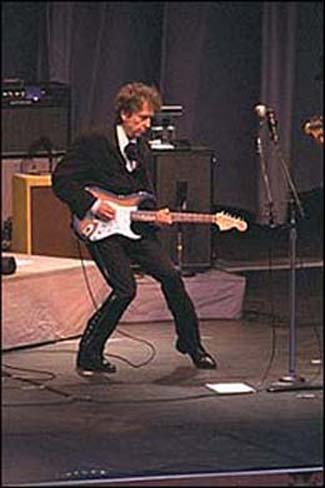
Two seemingly unrelated events that happened on this date, 151 years apart, merge to illuminate the endless vitality of the English language.
The first event took place on July 25, 1814. British engineer George Stephenson demonstrated the first steam locomotive. The second event took place on July 25, 1965 at the Newport, Rhode Island Folk Music Festival. For the first time ever, Bob Dylan performed with an electric guitar.
Besides the date, these two events both deal with inventions that were later improved upon or at least altered in some significant way. The alteration was such that the name also changed. For example, the word guitar was a fairly straight forward term for a stringed instrument, but the invention of the electric guitar required that a new adjective be attached to guitar to distinguish the plugged version from the unplugged version. The word used is acoustic, and it's an example of a class of words called retronyms. The word locomotive lead to the retronym steam locomotive when the electric and diesel locomotives came on the scene.
A retronym, as defined by the American Heritage Dictionary is: "A word or phrase created because an existing term that was once used alone needs to be distinguished from a term referring to a new development, as snail mail in contrast to e-mail.
The word was coined by Frank Mankiewicz, one-time press secretary for Robert F. Kennedy. He used existing Greek roots to create: retro (Greek, backwards) + nym (Greek, name).
Probably the largest collection of retronyms can be found at the web site of Barry Stiefel who has catalogued 112 examples. Here are a few examples that show the variety of categories that retronyms can fall under:
politics: absolute monarchy
communications: AM radio
family: biological parent
warfare: conventional weapons
computers: corded mouse
sports: natural turf (1)
Today's Challenge: A Retro By Any Other Nym
Given the name of the new idea or invention, see if you can name the retronym.
Example: Color television. Retronym: black and white television
1. surrogate mother
2. online journalism
3. New Coke
4. disposable diapers
5. microwave oven
6. digital camera
7. paperback book
8. nuclear warfare
9. New Testament
10. World War II
Quote of the Day: This paperback is very interesting, but I find it will never replace a hardcover book - it makes a very poor doorstop.--Alfred Hitchcock
Answers: 1. birth mother 2. print journalism 3. Classic Coke 4. cloth diapers 5. conventional over 6. film camera 7. hardcover book 8. conventional warfare 9. Old Testament 10. World War I
1 - Stiefel, Barry. Retronym: Aspiring To Be The World's Largest Collection Of English Language Retronyms (112 And Counting!)
http://www.barrystiefel.com/retronym.htm
The first event took place on July 25, 1814. British engineer George Stephenson demonstrated the first steam locomotive. The second event took place on July 25, 1965 at the Newport, Rhode Island Folk Music Festival. For the first time ever, Bob Dylan performed with an electric guitar.
Besides the date, these two events both deal with inventions that were later improved upon or at least altered in some significant way. The alteration was such that the name also changed. For example, the word guitar was a fairly straight forward term for a stringed instrument, but the invention of the electric guitar required that a new adjective be attached to guitar to distinguish the plugged version from the unplugged version. The word used is acoustic, and it's an example of a class of words called retronyms. The word locomotive lead to the retronym steam locomotive when the electric and diesel locomotives came on the scene.
A retronym, as defined by the American Heritage Dictionary is: "A word or phrase created because an existing term that was once used alone needs to be distinguished from a term referring to a new development, as snail mail in contrast to e-mail.
The word was coined by Frank Mankiewicz, one-time press secretary for Robert F. Kennedy. He used existing Greek roots to create: retro (Greek, backwards) + nym (Greek, name).
Probably the largest collection of retronyms can be found at the web site of Barry Stiefel who has catalogued 112 examples. Here are a few examples that show the variety of categories that retronyms can fall under:
politics: absolute monarchy
communications: AM radio
family: biological parent
warfare: conventional weapons
computers: corded mouse
sports: natural turf (1)
Today's Challenge: A Retro By Any Other Nym
Given the name of the new idea or invention, see if you can name the retronym.
Example: Color television. Retronym: black and white television
1. surrogate mother
2. online journalism
3. New Coke
4. disposable diapers
5. microwave oven
6. digital camera
7. paperback book
8. nuclear warfare
9. New Testament
10. World War II
Quote of the Day: This paperback is very interesting, but I find it will never replace a hardcover book - it makes a very poor doorstop.--Alfred Hitchcock
Answers: 1. birth mother 2. print journalism 3. Classic Coke 4. cloth diapers 5. conventional over 6. film camera 7. hardcover book 8. conventional warfare 9. Old Testament 10. World War I
1 - Stiefel, Barry. Retronym: Aspiring To Be The World's Largest Collection Of English Language Retronyms (112 And Counting!)
http://www.barrystiefel.com/retronym.htm
Tuesday, July 25, 2006
July 25: Retronym Day
Two seemingly unrelated events that happened on this date, 151 years apart, merge to illuminate the endless vitality of the English language.
The first event took place on July 25, 1814. British engineer George Stephenson demonstrated the first steam locomotive. The second event took place on July 25, 1965 at the Newport, Rhode Island Folk Music Festival. For the first time ever, Bob Dylan performed with an electric guitar.
Besides the date, these two events both deal with inventions that were later improved upon or at least altered in some significant way. The alteration was such that the name also changed. For example, the word guitar was a fairly straight forward term for a stringed instrument, but the invention of the electric guitar required that a new adjective be attached to guitar to distinguish the plugged version from the unplugged version. The word used is acoustic, and it's an example of a class of words called retronyms. The word locomotive lead to the retronym steam locomotive when the electric and diesel locomotives came on the scene.
A retronym, as defined by the American Heritage Dictionary is: "A word or phrase created because an existing term that was once used alone needs to be distinguished from a term referring to a new development, as snail mail in contrast to e-mail."
The word was coined by Frank Mankiewicz, one-time press secretary for Robert F. Kennedy. He used existing Greek roots to create: retro (Greek, backwards) + nym (Greek, name).
Probably the largest collection of retronyms can be found at the web site of Barry Stiefel who has catalogued 112 examples. Here are a few examples that show the variety of categories that retronyms can fall under:
politics: absolute monarchy
communications: AM radio
family: biological parent
warfare: conventional weapons
computers: corded mouse
sports: natural turf (1)
Example: Color television. Retronym: black and white television
1. surrogate mother
2. online journalism
3. New Coke
4. disposable diapers
5. microwave oven
6. digital camera
7. paperback book
8. nuclear warfare
9. New Testament
10. World War II
Quote of the Day: This paperback is very interesting, but I find it will never replace a hardcover book - it makes a very poor doorstop.
--Alfred Hitchcock
Answers: 1. birth mother 2. print journalism 3. Classic Coke 4. cloth diapers 5. conventional over 6. film camera 7. hardcover book 8. conventional warfare 9. Old Testament 10. World War I
1 - Stiefel, Barry. Retronym: Aspiring To Be The World's Largest Collection Of English Language Retronyms (112 And Counting!)
http://www.barrystiefel.com/retronym.htm
The first event took place on July 25, 1814. British engineer George Stephenson demonstrated the first steam locomotive. The second event took place on July 25, 1965 at the Newport, Rhode Island Folk Music Festival. For the first time ever, Bob Dylan performed with an electric guitar.
Besides the date, these two events both deal with inventions that were later improved upon or at least altered in some significant way. The alteration was such that the name also changed. For example, the word guitar was a fairly straight forward term for a stringed instrument, but the invention of the electric guitar required that a new adjective be attached to guitar to distinguish the plugged version from the unplugged version. The word used is acoustic, and it's an example of a class of words called retronyms. The word locomotive lead to the retronym steam locomotive when the electric and diesel locomotives came on the scene.
A retronym, as defined by the American Heritage Dictionary is: "A word or phrase created because an existing term that was once used alone needs to be distinguished from a term referring to a new development, as snail mail in contrast to e-mail."
The word was coined by Frank Mankiewicz, one-time press secretary for Robert F. Kennedy. He used existing Greek roots to create: retro (Greek, backwards) + nym (Greek, name).
Probably the largest collection of retronyms can be found at the web site of Barry Stiefel who has catalogued 112 examples. Here are a few examples that show the variety of categories that retronyms can fall under:
politics: absolute monarchy
communications: AM radio
family: biological parent
warfare: conventional weapons
computers: corded mouse
sports: natural turf (1)
Today's Challenge: A Retro By Any Other Nym
Given the name of the new idea or invention, see if you can name the retronym.Example: Color television. Retronym: black and white television
1. surrogate mother
2. online journalism
3. New Coke
4. disposable diapers
5. microwave oven
6. digital camera
7. paperback book
8. nuclear warfare
9. New Testament
10. World War II
Quote of the Day: This paperback is very interesting, but I find it will never replace a hardcover book - it makes a very poor doorstop.
--Alfred Hitchcock
Answers: 1. birth mother 2. print journalism 3. Classic Coke 4. cloth diapers 5. conventional over 6. film camera 7. hardcover book 8. conventional warfare 9. Old Testament 10. World War I
1 - Stiefel, Barry. Retronym: Aspiring To Be The World's Largest Collection Of English Language Retronyms (112 And Counting!)
http://www.barrystiefel.com/retronym.htm
Subscribe to:
Posts (Atom)
